Deep dive
Letting your arms simply hang while sitting, with no support, means your neck and upper back muscles are constantly working to hold them up. This page covers the mechanics behind that and the concrete levers you can pull — desk height, armrests, monitor position, and exercises. Every claim links directly to its source.
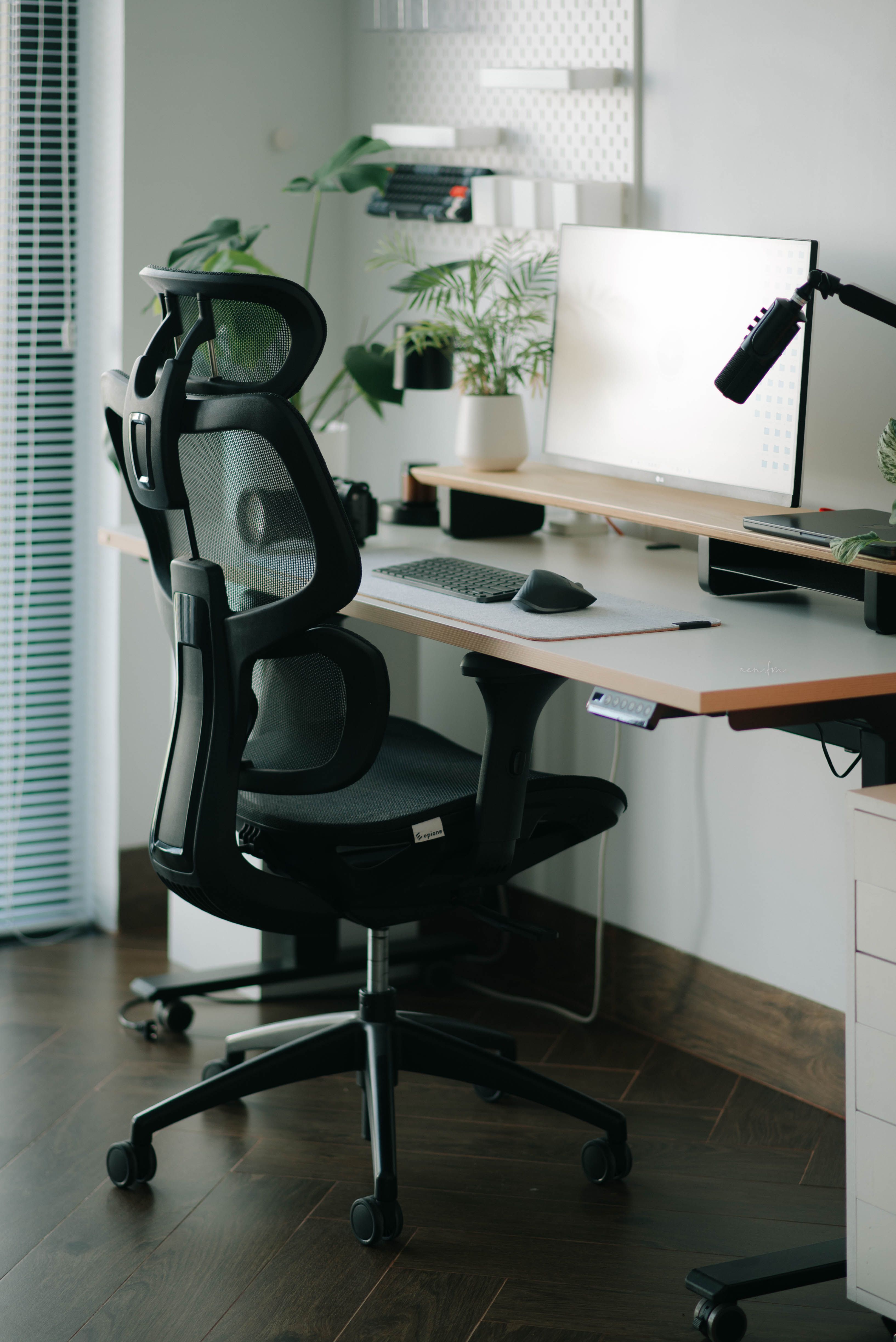
The reason lies in anatomy: the shoulder blade and arm have only a single bony connection to the rib cage — the collarbone, which acts like a strut. When the arms hang unsupported, this connection is under constant tension instead of relief, and it's exactly these two muscles that have to absorb it.
Source: dr-gumpert.de: Musculus trapezius, Praxis Dr. Peter Neef: Neck muscle tension
At a normal walking pace, arm swing is mostly a passive, pendulum-like motion that arises simply from the dynamics of the body’s linked segments — not from sustained muscle contraction. As pace increases, say when jogging, the active muscle contribution grows, but it stays rhythmic: contraction and relaxation alternate with every step. That’s exactly what sets it apart from sitting with unsupported arms, where the trapezius and levator scapulae have to hold the arms up statically, without a break. This sustained contraction measurably restricts local blood flow in the muscle — and with it, oxygen supply and the removal of metabolic byproducts — a mechanism documented in chronic trapezius tension. Rhythmic movement like walking or jogging, by contrast, restores blood flow with every relaxation phase, letting the muscle recover continuously between contractions.
Source: Arm swing in human locomotion (overview article), Larsson et al., Pain (1999): trapezius blood flow in chronic neck tension
If there isn't enough surface to rest the arms lengthwise, it helps to place them across the desk instead — what matters is having any support at all, rather than letting the arms hang free.
Source: sehen.de: Optimized screen workstation (DGUV Information 215-410)
If the armrests are too wide and force the arms into a position with raised shoulders, it's usually better to remove them than to accept that poor posture permanently.
Source: DGUV Information 215-410, wiepa.com: Ergonomics at the workplace
If the monitor sits too low or too far to the side, it's often the same neck and shoulder muscles already strained by hanging arms that end up compensating.
Trapezius stretch: sit upright with your feet flat on the floor, reach your right hand over your head to your left temple, and gently pull your head to the right side while actively pulling your left shoulder down and back. Hold for 20 to 30 seconds, then switch sides.
Source: Zentrum für alternative Schmerztherapie: Upper back pain
The title echoes the phrase coined by Dr. James Levine (see Background) — the book itself is written by Kelly Starrett.
View bookNote: the methods presented in this book are debated among experts. Its mention here is a neutral reading tip, not an endorsement of the method by PostureShift.
View bookOn top of that, clamp and slot-in constructions tend to wobble and sway, and many models only fit desktop thicknesses of roughly 1 to 8.5 cm. Raising the desk or resting the arms across rather than lengthwise is often the more reliable solution in practice.
Our own assessment — based on general research into clamp-on desk solutions and personal user experience, no single source with a dedicated product test was found.